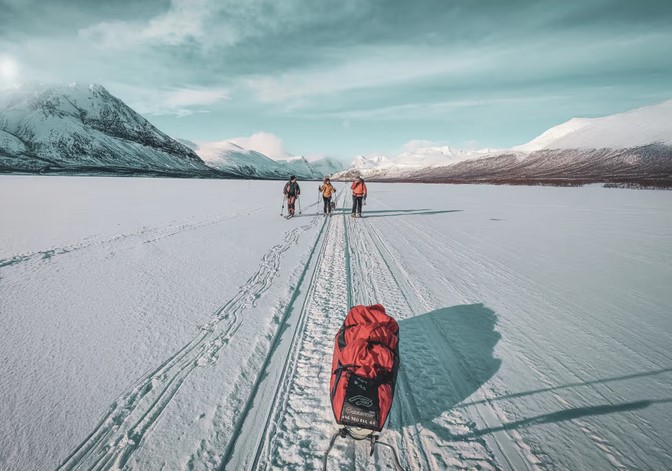
Your eyelashes are heavy with frost, and every breath feels like swallowing a thousand tiny needles. In the distance, the groan of a glacier shifting under its own weight sounds like a thunderclap in slow motion. Most hikers pack away their boots when the first snowflake hits the ground, but they are missing out on the world’s most dramatic transformation. Did you know that at $-30$°C, the acoustic properties of air change so significantly that you can hear a snapping twig from over a kilometer away?
I’ve spent the last decade navigating the frozen corridors of the Ladakh range and the sub-zero plateaus of Iceland. I’ve learned—often the hard way—bahwa winter frozen treks are not just “hiking in the cold.” It is a high-stakes game of thermal management and psychological grit. If you approach the ice with the same casual attitude as a summer stroll, the wilderness will bite back. But if you master the technicalities, you unlock a silent, monochromatic kingdom that few will ever see.
The Science of Survival: Why We Trek in the Freeze
Think of your body in the winter wilderness like a high-end smartphone battery. In warm weather, everything runs efficiently. But the moment the temperature drops, your “voltage” plummets. You burn calories up to 30% faster just to maintain a core temperature of $37$°C.
Winter frozen treks demand a shift from “traveling” to “operating.” You aren’t just walking; you are managing a biological furnace. Every decision—when to eat, when to delayer, and how to step—is a technical choice designed to prevent the two great enemies of the icy trail: Hypothermia and Frostbite.
Mastering the Three-Layer Technical System
If I could give one piece of advice to beginners, it would be this: Cotton is a death sentence. I remember seeing a novice trekker on the Chadar Trek wearing a thick cotton hoodie; within two hours, it was a frozen, heavy slab of ice against his skin. To survive the freeze, you need a modular system:
-
The Base Layer (Wicking): This is your “moisture manager.” Use high-grade Merino wool or synthetics. It pulls sweat away from your skin so you don’t freeze the moment you stop moving.
-
The Mid Layer (Insulation): This is your “heat trap.” Down (puffy jackets) offers the best warmth-to-weight ratio, but synthetic insulation (like Primaloft) is safer if there is a risk of getting wet.
-
The Shell (Protection): Your “armor.” A waterproof, breathable membrane like Gore-Tex is essential to block the “wind chill factor,” which can make a $0$°C day feel like $-15$°C.
Navigating the Ice: Crampons, Microspikes, and Snowshoes
Walking on a frozen river or a snow-clogged pass is like driving on a skating rink without winter tires. You need a “mechanical grip” to stay upright.
1. Microspikes for Beginners
For most intermediate winter frozen treks, microspikes are your best friend. They are elastomeric harnesses with small chains and spikes that fit over your regular boots. They provide enough traction for icy trails without the weight of full mountaineering gear.
2. Crampons for Steep Grades
If your trek involves “Blue Ice” or slopes greater than $20$°, you need crampons. These are serious steel spikes that require specific boots. My personal insight? Never use crampons for the first time on a dangerous ledge—practice the “duck walk” (flat-footing) on level ground first.
3. Snowshoes for “Post-Holing”
If you find yourself sinking up to your waist in soft snow—a phenomenon known as post-holing—you are wasting 4x more energy than necessary. Snowshoes increase your surface area, allowing you to “float” on top of the powder.
Global Destinations for Icy Immersions
-
The Chadar Trek, India: A 60-mile journey over the frozen Zanskar River. It is a technical masterclass in reading ice thickness and avoiding “shelf ice” collapses.
-
The Laugavegur Trail, Iceland: In winter, this turns into a surreal landscape of obsidian sand and neon-blue ice caves.
-
The White Mountains, USA: Home to some of the world’s fastest wind speeds, this is where intermediate trekkers go to test their winter frozen treks survival skills.
💡 Pro Tip: The “Hot Water Bottle” Lifehack
Before you go to sleep in your -20°C rated sleeping bag, fill a high-quality (BPA-free) plastic bottle with boiling water, wrap it in a spare sock, and shove it to the bottom of your bag. Not only does it act as a heater for your feet, but it also ensures you have liquid water to drink the next morning. In the deep freeze, your biggest struggle isn’t finding water—it’s keeping it from turning into a solid brick of ice.
The Hidden Danger: Dehydration in the Cold
This is the most common mistake I see. Because you aren’t “dripping with sweat” like in the tropics, you think you don’t need to drink. In reality, you lose massive amounts of moisture through respiratory evaporation (that white “smoke” when you breathe).
If you are thirsty, you are already dehydrated, which makes you more susceptible to cold-related injuries. Pro Insight: Use an insulated “hydration bladder” hose or keep your water bottle upside down in your pack. Since ice forms from the top down, keeping it inverted ensures the cap doesn’t freeze shut.
Essential Winter Gear Checklist
-
Vapor Barrier Liners (VBL): For multi-day treks, these stop your foot sweat from reaching your boot insulation and freezing overnight.
-
Polarized Category 4 Sunglasses: “Snow Blindness” is a real medical emergency caused by UV rays reflecting off the ice. You need side-shields to block peripheral light.
-
Headlamp with Lithium Batteries: Standard alkaline batteries die in minutes in the cold. Lithium cells are the only way to ensure you aren’t left in the dark during the long winter nights.
-
Emergency Bivvy: A lightweight, heat-reflective bag that can save your life if you are forced to stop moving.
Scannable Safety Protocol
-
Sweat is the Enemy: If you feel yourself getting hot, delayer before you start sweating. Wet clothes = cold bodies.
-
Sun Protection: The sun on ice is twice as strong. Apply sunblock to the underside of your nose and chin—the reflection will burn places you didn’t know could get sunburned.
-
Caloric Loading: Eat high-fat foods (nuts, chocolate, cheese). Your body needs “slow-burning logs” for the fire, not just “quick-burning paper” (sugar).
-
Check Your Toes: If you lose sensation in your extremities (the “umbles”: fumbling, mumbling, stumbling), stop and rewarm immediately.
Conclusion: The Silence of the Ice
There is a specific kind of peace found during winter frozen treks that is impossible to find elsewhere. It is a world without the hum of insects or the rustle of leaves—just the sound of your own heart beating and the crunch of ancient ice beneath your feet. It challenges your limits and forces you to be entirely present in every second.
The ice isn’t something to be feared; it is a landscape that demands respect and technical precision. Once you learn its language, the winter wilderness becomes the most beautiful home you’ve ever known.
Are you brave enough to trade the beach for the glacier this year? Or have you already experienced the magic of a sub-zero sunrise? Share your “frozen” bucket list in the comments below!